Once again we awoke to a beautiful clear, sunny day, perfect for the 190km drive along the Paroo Development Road. Our destination was Thargomindah. We have become accustomed to the nature of the land now, low growth trees and shrubs, predominantly blue grey mulga with salt bush nearer the ground, with an occasional bright green tree to break the monotony. As we passed through the water courses the trees changes to river gums and wherever there had been water, the wildflowers had grown and blossomed.
 |
| 071116 Mulga, mulga everywhere |
 |
071116 This time there were a couple of bright green trees
and wildflowers with the mulga |
 |
| 071116 Springvale, one of the many mud springs west of Eulo |
 |
| 071116 Top of a Mud Spring |
 |
| 071116 Mud springs explained |
We did pass an occasional sand hill and indeed, the land had become more undulating, not that incessant flat that we had east of Cunnamulla. The sheep and cattle we saw were few in number and there were several emus with chicks.
 |
| 071116 "Me and yous" near Eulo |
 |
| 071116 Waterless Lake Bindegolly, east of Thargomindah |
Eulo was the first town we passed through. We have visited Eulo previously and, rather than rewrite the Eulo story again, we have copied and pasted an excerpt from the earlier blog. While there was more water there than when we last visited, we have been assured by the locals, west of Cunnamulla received less than east of Cunnamulla. For this reason there has been no reason to update the Eulo story, except for a picture of the water just flowing over the Eulo weir this time.
 |
| 071116 This time the water was barely flowing over the Eulo Weir |
Start blog of 27 November 2014 We arose to a beautiful sunrise this morning which heralded another warm day, our guess about 36 degrees.
We headed off to Eulo, 68km west of Cunnamulla to see a date grove and the famous mud baths. Sadly, because we were early or more likely because it is out of the tourist season now, both places were not open. Still, it's surprising how much you can find when your first attempts are thwarted.
Eulo is on the Paroo River, often mentioned in news reports when it is in flood. It is quite distressing to see Eulo and its surrounding districts in the midst of a drought. The signed "Vegetated Spring" was as dry as dry, as was the Billabong and the Mud Springs on the Heritage Drive. The Paroo River is not flowing and it looks quite forlorn as rivers go.
 |
271114 Vegetated Spring - absolutely dry. Normally a spring flows to the
surface at this point. It is fenced to keep animals and stock away from it |
 |
| 271114 Dry billabong on the Paroo River |
 |
| 271114 Weir at Paroo River at Eulo. Just puddles of water below the weir |
 |
| 271114 Paroo River upstream of the weir |
While we were on the Heritage Drive we photographed some common Australian outback trees, so we have included photographs of these for the education of all.
 |
| 271114 River Red Gum - summer flowering for honey production |
 |
271114 Coolibah tree - produces honey in the summer month and for
swagmen to sit under |
 |
| 271114 Yapunyah tree, winter flowering for honey production |
 |
271114 Mulga - great stock feed during times of drought. Often see absence
of lower branches to height of feeding cattle |
 |
| 271114 Bimble Box - spring flowering for honey production |
 |
| 271114 Gidyea tree - used for fencing and stock yard building |
In spite of the harsh conditions, Eulo has grasped the nettle and selected one iconic animal as its source of uniqueness and humour, the humble lizard. We were assured there are many lizards there but we did not see one real one.
 |
| 271114 These small towns crave something iconic, in Eulo's case, lizards |
 |
| 271114 Saw us and skedaddled up this mast in defence mode |
 |
271114 The world champion lizard racing track. Racing commenced in 1967
and races are held annually in August/September as part of a joint festival
between Cunnamulla, Yowah and Eulo |
 |
| 271114 The Eulo Lizard Lounge |
Back in 2011 the fossil of a Diprotodon Optatum, nicknamed "Kenny", was found near Eulo and he put Eulo on the map, and the locals have not let go of him since. They even have a bronze statue of him in the main street.
 |
271114 Diprotodon Optatum, largest Australian species of megafauna
and a marsupial. Developed and sculptured from a fossilised skeleton
called "Kenny", found near Eulo in 2011 |
We saw the Eulo Bore which is the source of the town's water. They are pumping from a reservoir in the Great Artesian Basin from a depth of about 223 m. The water comes up at 38 degrees and is not treated, beyond allowing it to cool.
 |
271114 The Eulo Bore at the base of the water tower. It pumps water from the
Great Artesian Basin for Eulo's water supply. |
The outback humour surfaced again at Eulo. We happened across the World Champion Lizard Racing Track and a plaque to "Destructo", a cockroach which defeated the champion racing lizard "Wooden Head", in 1980.
 |
271114 Truth is this NSW cockroach was killed by Queenslanders because
Queenslanders hate cockroaches |
We arrived back at the van with smiles on our faces but with a memory of how hard the locals are doing it in this time of drought.
Now continuing today's blog 7 November 2016. On the road again heading west of Eulo.
 |
071116 A load of cattle about to access the highway
from the direction of Quilpie |
 |
| 071116 Crossing the Bulloo at Thargomindah |
 |
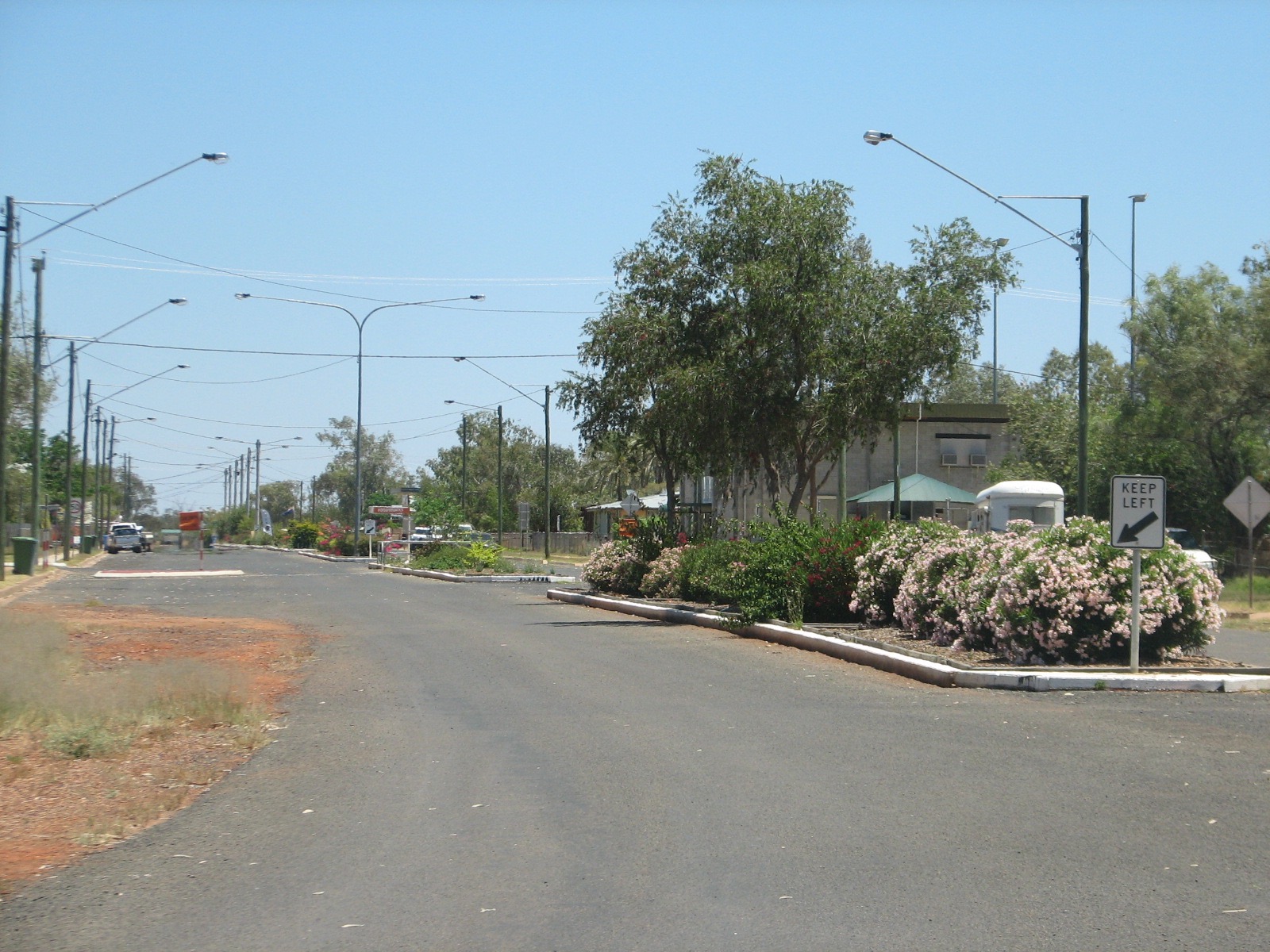
| 071116 Entering Thargomindah's main street |
Thargomindah's source of water is the Great Artesian Basin (GAB), so it was not surprising that there is much to do about the GAB in Thargomindah.
 |
071116 "Conduit above, below and between",
-a Frederick White Sculpture in Thargomindah |
 |
| 071116 The sculpture described |
 |
| 071116 Thargomindah's town bore |
 |
| 071116 Ponds for cooling the town's artesian water |
There are several points of historical interest in Thargomindah.
 |
071116 The first artesian water powered generator incorporating a
Pelton Wheel, which operated in 1898
|
 |
| 071116 Thargomindah's Pelton Wheel story |
 |
071116 Leahy Historical House built in 1885 and owned at
one time by sir Sydney Kidman |
 |
071116 Sign for the old crossing of the Bulloo River
|
 |
| 071116 The Cobb & Co Crossing on the Bulloo River |
 |
071116 The old Thargomindah Hospital
Of course the Bullo River features as well and the town makes use of a spot called Pelican Point for swimming and fishing. Unsurprisingly the Bulloo River is no different from the other western Queensland with its high turbidity and the resultant muddy colour.
|
 |
071116 The weir at Pelican Point on the
Bulloo River at Thargomindah |
 |
| 071116 Downstream of the Pelican Point Weir |
 |
| 071116 Upstream of the Pelican Point Weir |
 |
| 071116 The Bulloo River downstream of the bridge |
 |
| 071116 The Bulloo River upstream of the bridge |
 |
071116 Boat launching ramp at Thargomindah?
In the event of floods? |
It reached 39 degrees today and we were grateful, having done the touristy bits, to return to the air-conditioned comfort of the van. Mind you, it took almost two hours to get the temperature down to a comfortable 24 degrees. Quite a nice caravan park here, so that helps.