Pages

Saturday, 25 October 2014

Day 203 - Coober Pedy to Woomera

Today dawned overcast but still quite warm. We had to retrace our steps southward, this time passing through Glendamba and taking a left hand turn at Pimba for a short 6km drive to Woomera.

It was a big day yesterday so we decided to stop at Woomera after doing 371km in the morning, to recover a bit - and to watch the car race on the Gold Coast.

We drove all morning with a temperature of 30-31 degrees and an overcast sky.  In the distance we could see light showers falling but it was not until we neared Glendambo that we actually experienced rain. There was very little rain however and it never really wet the road.  One could become a great weather forecaster here given you can see forever in all directions.

The sky remains overcast, but we don't think the kangaroo and its joey and the several emus and chicks we saw on the way, will have to dive for shelter.
261014 A little ray of sunshine in a grey sky

261014 Leaden skies but little rain for us

261014 Light rain in the distance

261014 In the middle of a flat plain a flyover across the railway track

261014 The town of Woomera - no rockets today
.

Day 202 - Glendambo to Coober Pedy and tour of surrounds

Today we hustled to complete the 253 km drive from Glendambo to Coober Pedy before the temperature got too high.  This was probably to no avail as it got to 40 degrees by the end of the day.
251014 Typical countryside 250km of it from Glendambo to Coober Pedy,
absent the ridges. The ridges are mullock heaps and started to appear
about 15km from Coober Pedy.
251014 Coober Pedy welcome - an old"blower" truck
251014 The main street in Coober Pedy
We settled down at a caravan park and then headed off to do a tour of the town and its surrounds. The town's population is around 3500 and a lot of them do live underground. Coober Pedy is aboriginal for "whiteman burrows" or something to that effect.

We were rather surprised at the mining methods.  They drill down to 30m or so to find a "level" or seam of "colour" which signifies the presence of opal.  They then go down and drill horizontally, using explosives to loosen the rock.  The "pudge", rock not containing opal, is sucked out by a "blower" and left in piles and there are thousands of these piles of "mullock"over the countryside.  There is no obligation to put the mullock back in the holes.

251014 Opal mining at Coober Pedy 
251014 A noodling machine to test the mullock heaps


251014 Opal in situ - in a "level"
251014 Living quarters in an old mine
We drove through many miles of these piles.  There is a hole alongside each one and the place is quite dangerous.  One wouldn't lightly walk around these areas.

The tour took us to The Breakaways, where the flat mesa top drops away to the plain below, exposing the  colourful cliffs and nearby hills.  We saw the "dog fence" built to stop dingoes entering the stock growing areas in the south.
251014 Scenery at the Breakaways
251014 From a hill at the Breakaways - tour bus included
251014 From a hill at he Breakaways
251014 A view from the Breakaways
251014 A kaolinite mountain in the Breakaways
251014 The "Dog Fence" near Coober Pedy
The visit to the Serbian Orthodox Church was a must.  Built underground, it is a "working" church and is unique by virtue of its siting and the beautiful carvings in the rocks within.  It was built by miners as a labour of love, in 19 months.  We dropped (poor choice of words) into an underground hotel for a beer at the end of the tour and boy, was it welcome.

251014 The exterior of the Serbian Orthodox Church in Coober Pedy
251014 A carving in the rock in the Serbian Orthodox Church in Coober Pedy
251014 Another carving in the rock in the Serbian Orthodox Church in Coober Pedy
251014 The interior of the Serbian Orthodox Church in Coober Pedy
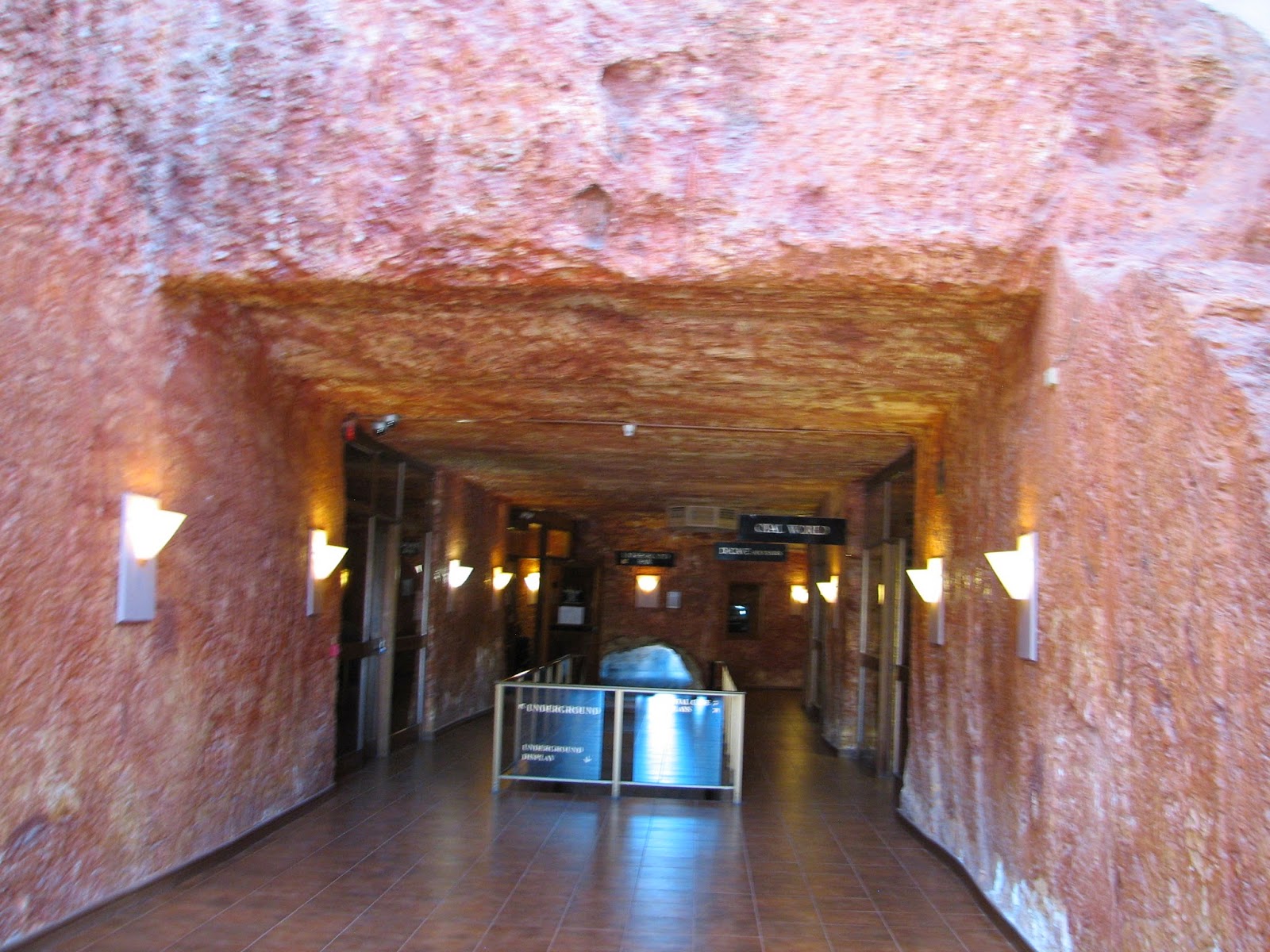
251014 Entrance to a hotel (underground)


251014 An underground house from outside - entrance at RHS

Friday, 24 October 2014

Day 201 - Hawker to Glendambo

Today we said goodbye to the northern Flinders Ranges and retraced our steps 105km to Port Augusta.  We then turned north onto the Stuart Highway with Coober Pedy our ultimate northerly destination.  It was a bit far away so we settled for the 291km to Glendambo.

From Port Augusta the countryside changed quickly to flat, saltbush covered plains with some Myall Acacia.  The further north we went, saltbush became the dominant plant growing in gibber type country.

We have passed two sizeable salt lakes, Island Lagoon and Lake Hart.  These are quite spectacular.  There has been no water evident so far and that is proven by the presence of flies, which assault our faces as they search for moisture on our skin.

It was hot all the way, reaching 39 degrees at around 2.00pm.  It's still 34 degrees in the van at 5.30pm.  There are some grey clouds about and a few spots of rain have fallen but they barely reached the ground.

Today we passed through two "communities", Pimba and Glendambo, our overnight stop. To be honest they are roadhouses with a pub each - designed for travellers.

We were accompanied most of the day by a water pipeline and a train.  Both the pipeline and the train line parallel the road.  They probably go to Roxby Downs.

241014 Typical countryside on the way to Glendambo, north of Port Augusta

241014 Island Lagoon a salt lake south of Pimba

241014 The "town" of Pimba

241014  Its a long way to The Alice

241014 Lake Hart salt lake


241014 Glendambo - a large roadhouse and pub


Thursday, 23 October 2014

Day 200 - Hawker to north of Lyndhurst

What a place the Flinders Ranges are.  Today we braved the heat once again and headed north from Hawker to a few kilometres north of Lyndhurst, which is 205km north of Hawker.

231014 Sign on our trip north from Hawker
231014 Flinders Ranges north of Hawker
The mountains followed us a fair part of the way but as we approached Parachilna, the first town on the road, the outback plains started to appear.  The countryside deteriorated and saltbush and spinifex were the most common vegetation.  We did see a few sheep and a few brumbies and the compulsory emu with chicks.  
231014 Brumbies alongside the road - poor looking country

231014 A big brumby in excellent condition in spite of the poor looking country
231014 Plenty of these even in Lyndhurst - walking away as usual

Parachilna was really only a pub, the Prairie Pub, but it went some way to guide intrepid travellers to its door with a menu of "Flinders Feral Food" - emu, kangaroo and quandongs - and an inducement of "all day grazing".
231014 The town of Parachilna. Population? Our estimate 25

231014 Add for Prairie Hotel at Parachilna - kangaroo, emu, quandongs on the menu
The town of Leigh Creek popped up next.  This is a relatively new town built in the period 1979-1983 to replace the original town 13 km to the north.  The original town was replaced as the Leigh Creek Coal Mine expanded to mine the coal resource under the old town. Leigh Creek has a population of about 600.
231014 The Gnome - the little spot in bottom of the LH wheel

231014 Suburbia in Leigh Creek - a modern outback town 
and the only place with shade
The Leigh Creek Coal Mine has been operating since 1884 but open cut operations commenced in 1943.  The coal is now railed to the Thomas Playford and Northern Powers Stations in Port Augusta.  The mine is huge.  The overburden was obvious for at least 12 km alongside the roadway.  We could not access the mine.

231014 Overburden at Leigh Creek Mine


231014 Dark overburden at Leigh Creek Mine

231014 First water seen for days - in the vicinity of Leigh Creek Mine

231014 Second spot of water seen in days - everywhere else barren and dry

Lyndhurst was our next port of call.  It is an access point for Marree and the Birdsville Track and as well for the Strzelecki Track to Innamincka and Moomba.  We drove off the bitumen onto the gravel roads at the start of both these tracks and the roads were not good.  We did see some ochre cliffs on the road to Marree.  

231014 The start of the dirt road to Marree and then on to the Birdsville Track

231014 Ochre cliffs north of Lyndhurst 
231014  One of the tracks leading from Lyndhurst 
231014 Not that far away from the centre of Australia
231014 Dust all the way from Moomba
231014 We drove from the bitumen onto the dirt of the Strzelecki Track
We ceased our northern jaunt a few kilometres north of Lyndhurst. We had a sense of de ja vu as we drove southward to Hawker but the views were different so we were engaged with the countryside all the way.

Will we do the Strzelecki and Birdsville Tracks?  Maybe, maybe not.  The experience today exposed us to the harsh nature of the countryside and the risks associated with taking on such a challenge.

This completes our time in the Flinders Ranges and we value the experience.

Wednesday, 22 October 2014

Day 199 - At home at the Hawker Caravan Park

It was to be a hot day today so, after our big day yesterday, we decided to stay at home with the air-conditioner on - full.  It was the hottest day we have experienced so far and at one time was 39 degrees.  

 We won't let you suffer from photograph withdrawal, so following are two photographs which sum up our experience at Hawker, hot and dry and very little green grass.

221014 View from the caravan park at Hawker

221014 View into the caravan park at Hawker- no grass